
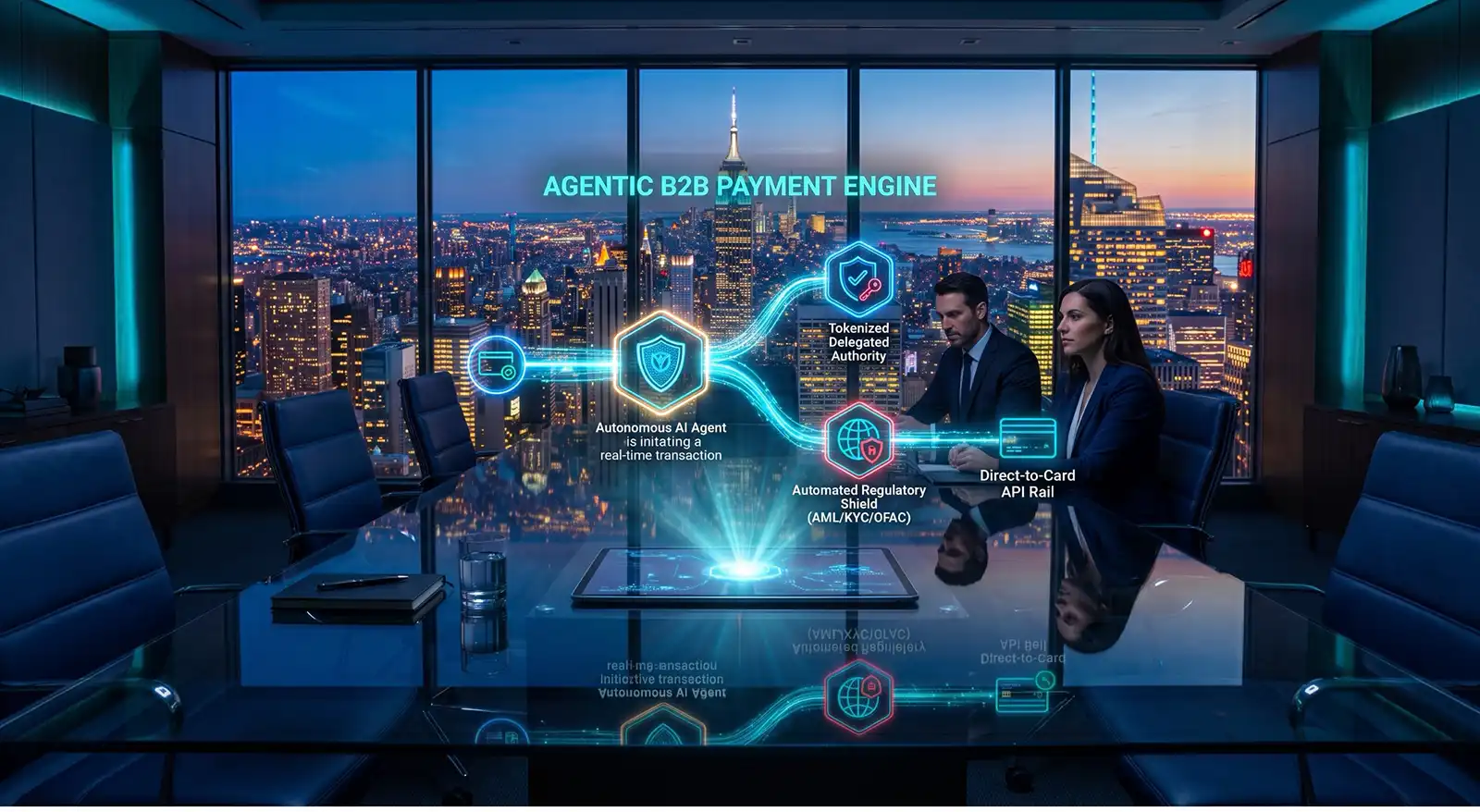
For the past decade, the financial industry has treated artificial intelligence as an advisory layer. We built copilots to analyze spend, predict cash flow, and flag anomalies. But in 2026, the paradigm has fundamentally shifted. We are no longer building software that tells humans how to transact; we are deploying autonomous AI agents that execute the transactions themselves.
This is the dawn of agentic commerce.
Agentic commerce is not a feature. It is a completely new architecture for global trade. When an AI agent is authorized to negotiate, procure, and settle a B2B invoice autonomously, the legacy financial infrastructure breaks down. Legacy rails were built for human latency. Agentic commerce demands machine-speed finality. To enable businesses to transact borderlessly, securely, and instantly in an AI-driven economy, we must rethink the very foundation of payment authorization.
The Architectural Failure of Legacy Rails
In traditional B2B commerce, a human reviews an invoice, logs into a portal, and initiates a wire transfer. This process tolerates the three-to-five-day delays and opaque intermediary fees inherent in legacy correspondent banking networks because humans have been conditioned to expect friction.
AI agents do not tolerate friction. They operate in milliseconds.
When a procurement agent identifies a supply chain shortage, sources a vendor in the APAC region, and initiates a purchase, it expects real-time programmatic settlement. If the payment rail requires manual reconciliation, human intervention for multi-factor authentication, or multi-day batch processing, the agentic workflow is severed. The system fails. You cannot run a 21st-century autonomous procurement engine on 20th-century financial infrastructure.
Architecting the Agentic Payment Infrastructure
To support autonomous B2B commerce, we cannot just patch legacy systems. We must architect a new environment where machine-to-machine transactions occur with absolute security and zero human bottleneck. This requires three structural pillars:
- Real-Time, Direct-to-Card Settlement: Agentic payments require instantaneous capital velocity. By utilizing direct-to-card API architectures, agents can push and pull funds globally settling transactions instantly across networks like UnionPay, rather than waiting days for correspondent banks to clear funds.
- Tokenized Delegated Authority: You cannot hand a corporate credit card number to a large language model. Agentic commerce relies on dynamic, single-use tokenization. The agent is granted a programmatic credential bound by strict cryptographic parameters: approved vendors, maximum spend limits, and highly specific timeframes.
- The Automated Regulatory Shield: Compliance is not a feature you tack onto the end of an AI transaction. It must be the very architecture of the system. Every autonomous transaction must pass through an automated background shield—executing real-time KYC, AML, and OFAC sanctions screening before the payment ever routes to the card networks. Protecting your permission to operate is paramount when machines are spending capital.
The Competitive Moat of Agentic Readiness
In global commerce, technological innovation is a distinct competitive advantage. Companies that architect their payment systems to accept automated, agent-driven inbound payments will capture yield from the most efficient buyers in the market. Those tethered to legacy wires and manual invoicing will be engineered out of the procurement loop entirely.
We are actively transitioning the industry away from the manual friction of the past and toward real-time, API-driven commerce. The agents are already here. It is time to upgrade the rails they run on.
About the Author: Cleveland Brown is the Co-founder and CEO of Payscout. Drawing on a foundation in philosophical frameworks from UCLA, he has spent over 25 years architecting global payment systems and scaling high-performing corporate cultures. He is a pioneer in removing friction from global commerce, specializing in cross-border payment infrastructure, automated regulatory compliance shields, and the next generation of financial technology, including immersive VR/XR commerce and agentic payment solutions.