TL;DR Summary: Paying suppliers and contractors in Africa is historically slow and expensive for US businesses due to complex, multi-hop correspondent banking networks that extract unpredictable fees. By bypassing legacy SWIFT wires and utilizing Payscout’s direct-to-card and local rail settlement via a unified API, US organizations can achieve near-instantaneous settlement finality and improve supply chain relations on the continent.
In traditional corporate treasury, Accounts Receivable (AR) is fundamentally reactive. Invoices are generated, sent into the digital ether, and subjected to unpredictable payment cycles, manual match-backs, and human approval delays. For decades, businesses accepted this friction as an inevitable cost of doing business.
At Payscout, we view AR differently. Accounts Receivable is not a clerical waiting room; it is an active financial engine. In an agentic economy, reactive AR is an architectural vulnerability. To scale capital velocity, organizations must transition to Autonomous AR powered by multi-agent AI architectures.
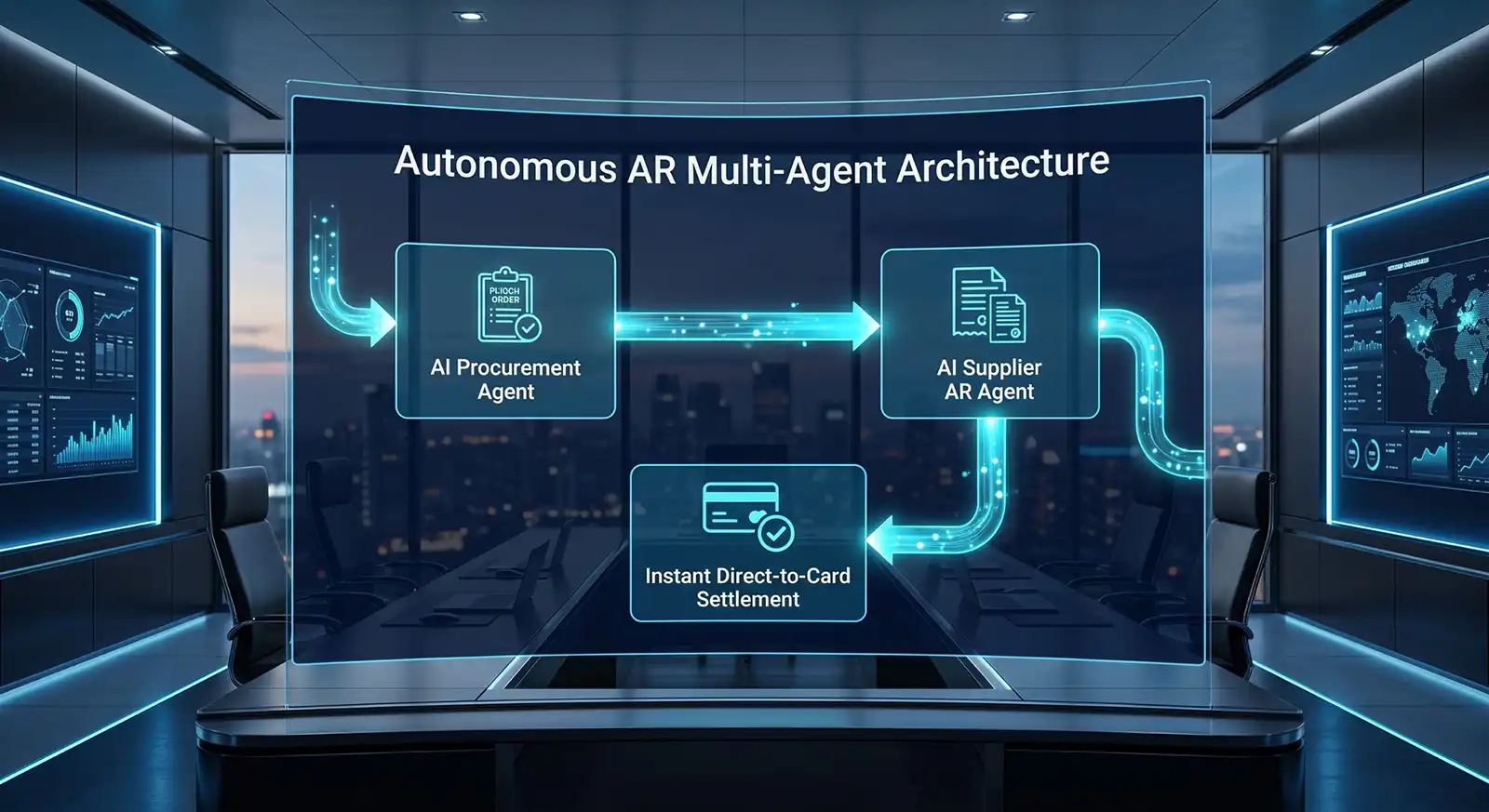
The Architecture of Multi-Agent AR
When a buyer’s autonomous procurement agent interacts with a vendor’s system, humans are no longer facilitating the exchange. Instead, specialized AI agents must negotiate, validate, and execute the transaction machine-to-machine.
An optimized Autonomous AR stack relies on three interconnected agent layers:
| Agent Layer | Core Function | System Outcome |
|---|---|---|
| 1. Reconciliation Agent | Matches incoming line-item payments against open ERP invoices in real time. | Eliminates manual cash application and unallocated batch holds. |
| 2. Dynamic Terms Agent | Evaluates real-time liquidity and offers instant, algorithmic early-payment discounts. | Maximizes yield and incentivizes immediate buyer settlement. |
| 3. Routing & Settlement Agent | Selects optimal payment rails based on fee structure, FX exposure, and speed requirements. | Bypasses slow correspondent wires in favor of direct-to-card rails like UnionPay. |
Eliminating the Manual Match-Back Bottleneck
The primary friction point in legacy B2B payments is cash application—matching an incoming wire to a specific purchase order. When legacy wires drop into a bank account stripped of rich metadata, human accounting teams waste hours manually reconciling payments.
Autonomous AR solves this at the protocol level. AI agents embed cryptographic metadata directly into the payment instruction. The moment the transaction executes via direct-to-card APIs, the receiving AR agent automatically reconciles the ledger, closes the open invoice, and updates the ERP within seconds.
By removing human latency from cash application, businesses turn Accounts Receivable into a real-time liquidity pipeline.
About the Author
Cleveland Brown is the Co-founder and CEO of Payscout. Drawing on a foundation in philosophical frameworks from UCLA, he has spent over 25 years architecting global payment systems and scaling high-performing corporate cultures. He is a pioneer in removing friction from global commerce, specializing in cross-border payment infrastructure, automated regulatory compliance shields, and the next generation of financial technology.